
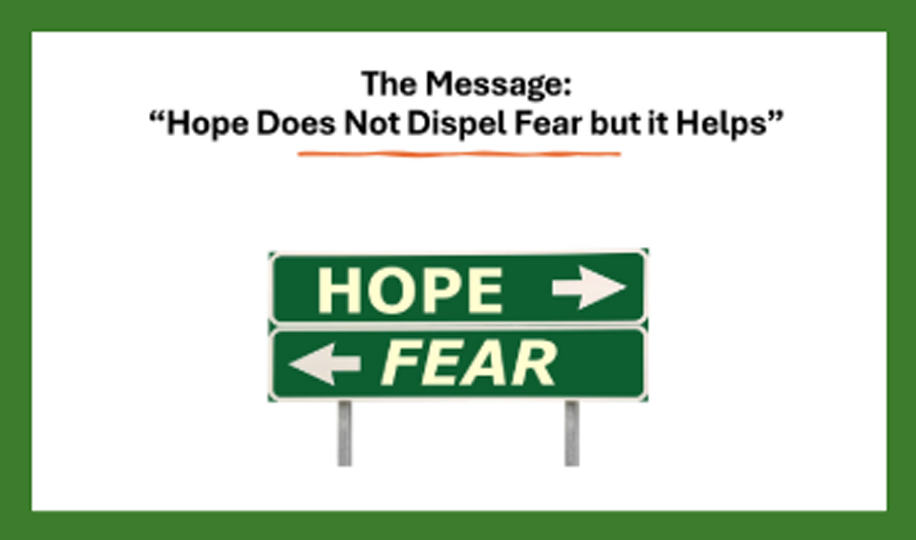
Hope Does Not Dispel Fear but it Helps
November 30, 2025
On the first Sunday of Advent, we light a candle representing ‘Hope’. We even encouraged people to tie one on for hope. But the scripture lessons would suggest that there is no hope or peace or joy and scant love in the world and I don’t see a baby making much difference. So, we have to step back, and appreciate that the first two Sundays of Advent are really about preparation.
These Sundays challenge us to ask, how can we prepare for the birth of the Christ child in this chaos? This is an important question to ask at a time when as I said to the kids last week that our brains are on fire. Every news story on social media or on the radio or in the newspaper sets our brains on fire and that’s just what’s happening in the world. Many of us have things going on in our own personal lives that are setting our brains on fire as well. Is this really the kind of world that we want to bring a child into? Can we do anything that would affect the state of the world today? In many ways this is the question posed by the gospel lesson that is so filled with a heaviness around the end of times.
The scripture which talks about two images the story of Noah and the End times when the chosen of the world are taken up and those who are not chosen by God are left behind. As you probably know this image spawned a whole series of books called the ‘Left Behind’ series. The scholar Rev. Dr. David Bartlett says that these stories tend to elicit two very different reactions. One approach by we who are the insiders, the good churchgoers, is to say well obviously we are the elect whom God loves so we have nothing to worry about. The second response is to see the end times everywhere we look. Which becomes another reason to be hyper vigilant in what we do and say and think. Just another reason for our brains to be on fire.
Rev. Bartlett says that these two camps or reactions each have a problem. On the one hand, those Christians, who are blasé about the end of times can easily fall into a state of perpetual apathy. We’re great, we’re great there is nothing to worry about. While those who are focused on the last things can easily fall into a state of perpetual anxiety. A couple of years ago, I saw somebody who was actually selling survival kits for the zombie apocalypse, and there were buyers out there. Talk about off the chart anxiety! Apathy and anxiety, which stand at the opposite ends of a continuum both lead to unhealthy behaviors. And we have seen this not just within our generation, but it seems like in every decade and generation. Every day there seems to be a new reason to worry about the end of times or we just try to hide our heads under the pillow. And this experience is unique to us, no. It was true in the time of Jesus and every era in between. For example: In the play Macbeth, which the Stratford Theatre had a very interesting take on this summer, there is a line where Macbeth says, “Life is a tale told by an idiot, full of sound and fury, signifying, nothing.”
I can’t figure out if MacBeth is filled with apathy or anxiety.
I think that we who are in the church would say that the Bible is a tale told by a strong and sovereign God, signifying any eternity that we cannot grasp because we live in the midst of a history, of which we can only possess a thin sliver of. Last week, I was reminded of the writings of Dr. Phyllis Trible. As the editor of the religious page for the New York Times, Dr. Trible read lots of books on history and theology. She noticed a pattern that every 500 years there is a tremendous social convulsion, where all the old standards and shared social rules collapse. Then slowly out of those ashes, something new was born. In those chaotic in-between times, it is easy to believe that this is it, the end times have arrived. Then slowly something new emerges. Now this is not to say that we only have to feel anxious or apathic every 500 years but rather that society is constantly changing either toward collapse or out of collapse. It will always feel like the end of times and that is the human condition. We might cluck our tongues at the behaviour of past generations in the middle of their collapse and their calamities, but when collapse comes in time or family tragedy brings us to our knees, the laughing stops. Which is why we actually need passages like this to help us prepare not just for the birth of Christ but for the birth of hope in our personal lives or amid the social chaos.
Ultimately, this passage is a passage of hope. In this passage, Jesus has us look all the way back to Noah. The Noah story is a cautionary tale about the foolishness of the humanity, the results of that foolishness, and the promise of God to always be there. A promise that God is preparing a safe landing place for us. The Noah story isn’t just about the rain. It’s about what happens during the rain and after the rain stops. The ark is a symbol of a people who make a safe haven and then seek a new home for all the animals in the ark including Noah and his family.
Part of the power of community is that together we can share stories of the past hardships of our lives and then share how God led us to those safe shores where we can begin again. The hope of this passage is to know that even when the rain is beating hard upon our heads, God is already at work, making sure that there will be a safe place for us to land. If you listen to the words of most of our carols, implicit in the hymn is a hardship. The Carol that we just sang, “Angels We have Heard on High” reminds us that Jesus was born in a manger. This was a time of severe oppression that Mary and Joseph had to endure. But they had faith that God was going to be with them as they brought this child into that harsh world. Sometimes hope is hard to find and that’s why we need faith to help us look for it. That is why we need community to speak of it. And that is why we need to find it.
When I consider the last lunch and workshop that we are invited to today, right after worship and I hope you have planned to stay for it. One of the questions we have to answer, whether we amalgamate or not, is ‘why?’ Why do we gather? Why would anyone outside the church care? What is our ‘why’ for existing? I think a big part of the why is that we have a story tell and hope to offer in a time of confusion, conflict, apathy and anxiety. Like in the story of Noah. A family huddled together trying to save not just themselves but all manner of life in the face of a destroying flood. The church is like the ark where yes, we are trying to save ourselves, but we are also mindful of all life, great and small, and we have a God given responsibility to offer this sanctuary to all those caught up in the chaos of life. This calling moves us out of apathy and toward hope not anxiety. This my friends, is a message the world desperately needs to hear today. Because people need to know there is hope and a place where a child, their child and themselves can be loved and grounded in a chaotic world. Amen